Skip to content
🎉 Welcome! Enjoy your reading, and I hope you will learn something new.

Cipher block chaining (CBC)

AES Cipher Block Chaining is the most commonly used mode of operation. It uses the previous output to XOR the next input.
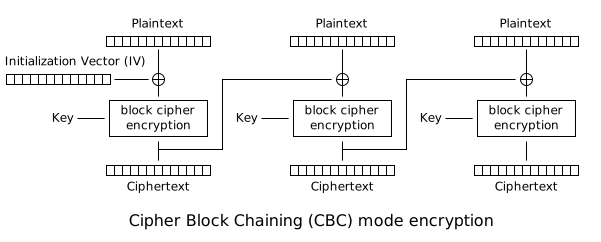
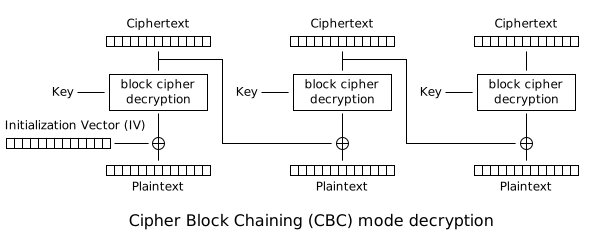
CBC Mode - Encryption CBC Mode - Decryption

IV / Nonce Recovery

If you send to the oracle a ciphertext of two blocks \(C_1\) and \(C_2\) to decrypt, such that \(C_1 = C_2 = 0\), then by construction you have

\[ \begin{aligned} P_1 &= IV \oplus D_K(C_1) \\ P_2 &= C_1 \oplus D_K(C_2) \end{aligned} \]

which reduces to

\[ \begin{aligned} P_1 &= IV \oplus D_K(0) \\ P_2 &= D_K(0) \end{aligned} \]

You now recover \(IV\) by calculating

\[ \begin{aligned} P_1 \oplus P_2 &= (IV \oplus D_K(0)) \oplus D_K(0) \\ &= IV \oplus D_K(0) \oplus D_K(0) \\ &= IV \\ \end{aligned} \]
cbc_iv_recovery.py
 1
 2
 3
 4
 5
 6
 7
 8
 9
10
11
12
# https://github.com/jvdsn/crypto-attacks/blob/master/attacks/cbc/iv_recovery.py
from Crypto.Util.strxor import strxor


def attack(decrypt_oracle):
    """
    Recovers the initialization vector using a chosen-ciphertext attack.
    :param decrypt_oracle: the decryption oracle to decrypt ciphertexts
    :return: the initialization vector
    """
    p = decrypt_oracle(bytes(32))
    return strxor(p[:16], p[16:])

Attacks

Padding oracle

If you have the ciphertext \(c\) of a message \(m\) you want to decrypt and an access to a decryption oracle using AES-CBC, that allows you to detect a change in behaviour depending and the correctness of the padding of the enyrpted message, then you can recover \(m\) using this oracle.

cbc_padding_oracle.py
 1
 2
 3
 4
 5
 6
 7
 8
 9
10
11
12
13
14
15
16
17
18
19
20
21
22
23
24
25
26
27
28
29
30
31
32
33
34
35
# https://github.com/jvdsn/crypto-attacks/blob/master/attacks/cbc/padding_oracle.py
import logging

from Crypto.Util.strxor import strxor


def _attack_block(padding_oracle, iv, c):
    logging.info(f"Attacking block {c.hex()}...")
    r = bytes()
    for i in reversed(range(16)):
        s = bytes([16 - i] * (16 - i))
        for b in range(256):
            iv_ = bytes(i) + strxor(s, bytes([b]) + r)
            if padding_oracle(iv_, c):
                r = bytes([b]) + r
                break
        else:
            raise ValueError(f"Unable to find decryption for {s}, {iv}, and {c}")

    return strxor(iv, r)


def attack(padding_oracle, iv, c):
    """
    Recovers the plaintext using the padding oracle attack.
    :param padding_oracle: the padding oracle, returns True if the padding is correct, False otherwise
    :param iv: the initialization vector
    :param c: the ciphertext
    :return: the (padded) plaintext
    """
    p = _attack_block(padding_oracle, iv, c[0:16])
    for i in range(16, len(c), 16):
        p += _attack_block(padding_oracle, c[i - 16:i], c[i:i + 16])

    return p

Bit-flipping attack

To quote the good explanation from Wikipedia :

A bit-flipping attack is an attack on a cryptographic cipher in which the attacker can change the ciphertext in such a way as to result in a predictable change of the plaintext, although the attacker is not able to learn the plaintext itself.

It is especially useful when you know the format of the underlying message and control the IV and ciphertext decoded. This means you can specifically choose where to modify the IV and ciphertext to produce the desired result on the decrypted plaintext, thus altering an essential part of the original message.

Attention

Be careful because while you can alter the structure of one block, the following ones will be complete garbage when decrypted, and you can’t compensate for that because you don’t know the underlying message.

cbc_bit_flipping.py
 1
 2
 3
 4
 5
 6
 7
 8
 9
10
11
12
13
14
15
16
17
18
19
20
# https://github.com/jvdsn/crypto-attacks/blob/master/attacks/cbc/bit_flipping.py
def attack(iv, c, pos, p, p_):
    """
    Replaces the original plaintext with a new plaintext at a position in the ciphertext.
    :param iv: the initialization vector
    :param c: the ciphertext
    :param pos: the position to modify at
    :param p: the original plaintext
    :param p_: the new plaintext
    :return: a tuple containing the modified initialization vector and the modified ciphertext
    """
    iv_ = bytearray(iv)
    c_ = bytearray(c)
    for i in range(len(p)):
        if pos + i < 16:
            iv_[pos + i] = iv[pos + i] ^ p[i] ^ p_[i]
        else:
            c_[pos + i - 16] = c[pos + i - 16] ^ p[i] ^ p_[i]

    return iv_, c_

Key == IV

When the IV is chosen as the key, AES becomes insecure. The Key can then be leaked if you have a acces to decryption oracle.

Tip

This attack is based on the same principle as the IV recovery; the only difference is that you also recover the key because the IV is the key.

Last updated on